By CJ Lindor
This week: Defining E-Motos, Mandatory Helmet Law for Youth E-bikers, and Local Control for E-Bike Speed Limits.
Our Bills + Bills We’re On
| Bill # | What We’re Calling It | Where It’s At |
| HF 3785 / SF 4186 | Defining E-Motos | Amended and Passed from Transportation, re-referred to Environment, Climate, and Legacy; referred to Rules and Administration |
| SF 3236 | Mandatory Helmet Law for Youth E-bikers | Amended and Passed from Transportation, re-referred to Finance; referred to Rules and Administration |
| SF 3280 | Local Control for E-bike Speed Limits | Amended and Passed from Transportation, re-referred to State and Local Government; referred to Rules and Administration |
E-Bikes vs. E-Motos this Week in the Senate
The focus for Active Mobility advocates this week at the Legislature was the Senate Transportation Committee hearing on Wednesday afternoon. Three separate bills to regulate E-Bikes and E-Motos were heard, as well as a report on Youth E-Bike Safety from the State’s Departments of Transportation and Public Safety. One was SF4186, BikeMN’s “Defining E-Motos” bill. While the 3 classifications for E-bikes are clearly defined, the classification for devices that exceed e-bike speed and/or power thresholds – i.e. E-Motos – is far-less apparent, and this bill provides clarification (though not a singular definition). The other 2 bills for e-bikes came from Senator Ann Johnson Stewart – SF3236 to require helmets for youth e-bike riders, and SF3280 to allow local control to set separate speed limits which would apply only to e-bikes. While BikeMN supports the author’s goals of increasing helmet usage and responsible riding behavior, we do not believe that punitive discretionary enforcement will be effective in achieving those goals and is likely to create new barriers and harm for people who walk, bike, or roll.
Regulating E-Motos Shouldn’t Be This Complicated
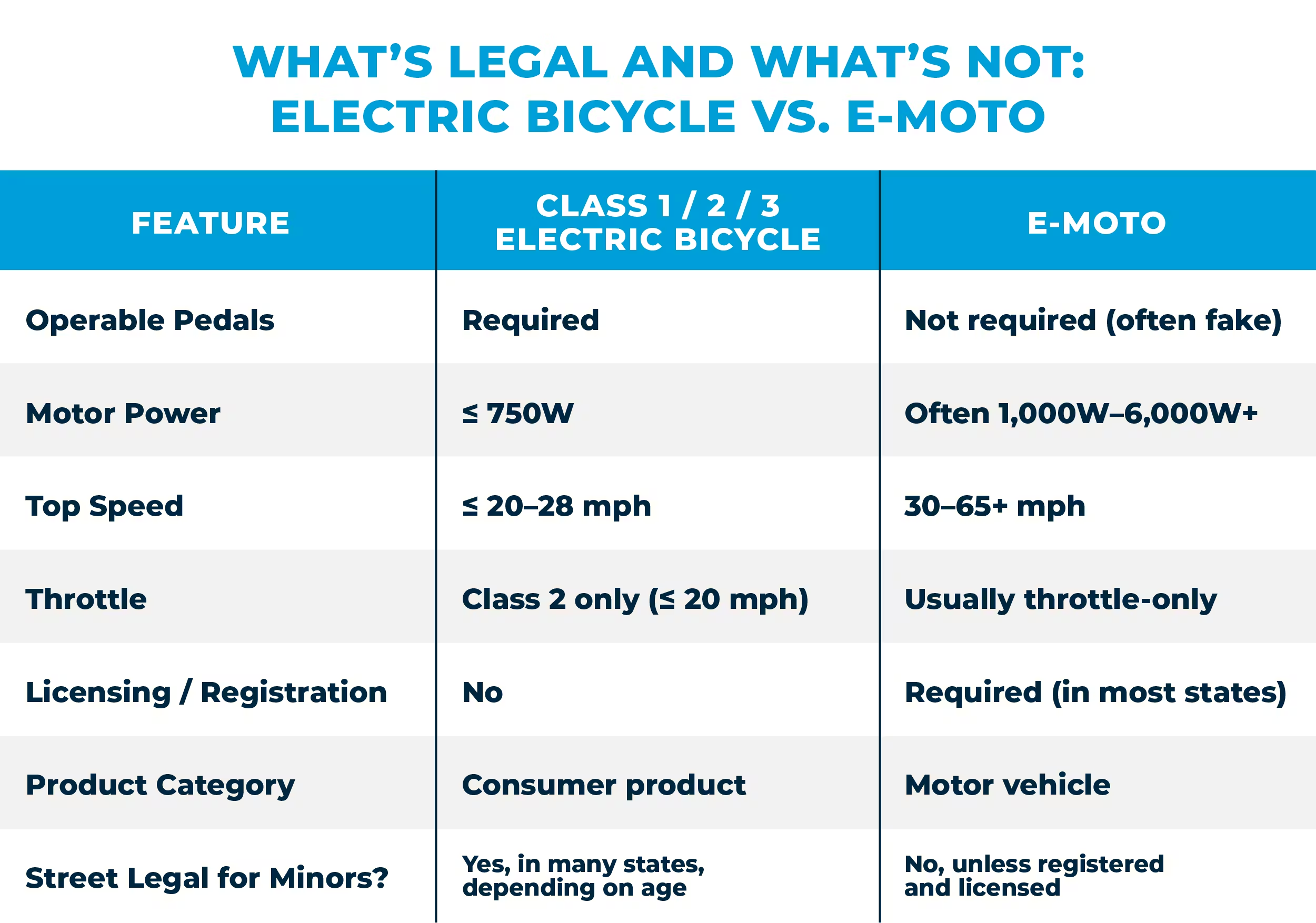
Thanks to BikeMN’s previous advocacy for the state to adopt People For Bikes 3-Class E-Bike definitions, it’s relatively straightforward to know if a device can be considered an “Electric-Assisted Bicycle” and be treated by law like a bicycle. For differentiating E-Bikes from E-motos, the most significant factor is this — top-speed with a throttle at 20mph or under is an E-Bike, any faster self-propelled and it’s now an “E-Moto”. (Only Class 2 E-Bikes have a throttle.)
E-Bikes are also limited to 1HP/750W maximum continuous output. Of course, it would be even easier to recognize a class-conforming e-bike if they were consistently labeled, which is supposed to be required in MN, but compliance is sporadic, at-best.
The bill to define E-Motos (HF3785/SF4186) clarifies that motor vehicles with 2 (or 3) wheels, a saddle, and handlebars, and that exceed 1HP/750W and/or 20mph under their own power is to be regulated as a motor vehicle in MN. This includes the proliferation of electric-powered 2-wheel motorized bicycles and motorcycles that we call “E-Motos”. The bill does not create a new vehicle classification in statute, but rather identifies several existing classes – Motorized Bicycle, Off-highway motorcycle, and Motorcycle – depending on the speed/power and registration, into which the vast majority of these devices would fit. (For the unique machines that don’t fit any of the above definitions, they would be regulated as a Motor Vehicle)
Despite some of the Senators’ professed difficulties in understanding perplexing terms like “20 miles per hour”, and “self-propelled”, it isn’t actually that complicated, and this bill would provide clarity about which regulations apply to these vehicles. Longtime BikeMN Legislative Committee member Matt Moore gave expert testimony and answered numerous questions from the Senators. Unlike electric-assisted bicycles, E-Motos are Motor Vehicles. Motor vehicles including E-Motos need to be registered and insured to be used on public roads. Operators of E-Motos need to be licensed to drive.
(Accessed at PeopleForBikes.org — The E-bike Problem is an E-moto Problem)
Are Pretext Stops the Best Way to Improve Safety for Youth E-Bikers?
While people who walk, bike, or roll along or across MN roads are already 4x more likely to be victims of traffic violence compared to a person driving a motor vehicle, youth are consistently the highest-risk age group across all users and face the greatest traffic risks of all. As the popularity of cycling grows, and particularly with the recent proliferation of affordable electric-mobility devices (and not coincidentally – E-Motos!), crash rates for youth has increased sharply in the past few years. This is a grave concern for everyone who cares about youth safety, and especially so for BikeMN.
Senator Johnson Stewart represents parts of the West Metro that have seen some of the greatest increases in E-Bike and E-Moto usage, especially by youth riders, and the concerns for public safety are very real and valid. However, we are concerned about negative impacts from discretionary punitive enforcement, and support more effective interventions to improve safety, including the 26 specific actions recommended by the Departments of Transportation and Public Safety’s Youth E-Bike Safety study. BikeMN brought several testifiers, including Brian Martinson from Met Council’s Transportation Advisory Board, Luke Van Santen from the West Metro Active Transportation Alliance, Matt Moore from the national industry trade group People For Bikes, and our contract lobbyist Christian Franzen to represent BikeMN’s Position on Mandatory Helmet Laws (excerpt):
“A mandatory helmet law moves attention and limited resources toward a policy with real costs and modest population-level benefit, and away from the work that would actually change the safety picture in Minnesota. We can do better, and the data shows us how.
BikeMN supports education and outreach on helmet use, programs that get helmets to people who need them, and — above all — the infrastructure investment that the evidence shows produces the largest and most equitable safety gains for everyone on the road.”
Separate Speed Limits Just for E-Bikes?
Yes, riding an e-bike does make it easier to go 20mph, and for the highest Class 3 E-Bikes, the pedal-assist provides up to 1HP/750W boost for up to 28mph. Studies have shown that e-bike riders average only a few mph faster than conventional bike riders. But these speeds are comparable to conventional bikes and still well-below the speed of other traffic, and there is zero evidence to suggest that further limiting e-bike speeds will improve road safety. On busy trails and multi-use paths, conflicts with other users can happen, but jurisdictions already can and do make ordinances to limit speeds on these facilities.
BikeMN agrees with Senator Johnson Stewart on the importance of responsible riding, especially around other people walking, biking, and rolling. However we don’t support SF3280 that would allow for speed limit ordinances that would apply only to e-bike riders within a business district, rather than equally to all users. BikeMN supports reducing speed limits for safety for ALL users on roads and trails, and focusing enforcement attention on the behaviors that create the greatest amount of danger and harm. Picking on e-bike riders is not the solution.
What’s Next for this Legislation?
Each of the 3 bills above was passed with amendments out of the Transportation Committee, to be sent to another committee stop. As of this writing, it’s unclear whether these bills will be taken up in a next committee and get referred to the Floor for a full vote in either chamber. It’s still conceivable that a bill heard in committee could be included in some sort of end-of-session negotiated omnibus package, but our understanding is this is an unlikely outcome for the current session. Indications from legislative leaders are that only bills with bipartisan support will be considered for final passage, and probably as standalone legislation rather than as part of a big omnibus bill. Of the 3, BikeMN’s “Defining E-Motos” seems to best fit the criteria of bipartisan legislation with broad support, but that’s still no guarantee that a vote will be taken.
BikeMN urges supporters who share our vision for a Safer and More Comfortable state for people to walk, bike and roll to contact the Transportation Committee Chairs – Senator Scott Dibble, Rep. Brad Tabke, and Rep. Jon Koznick to ask for Support for Defining E-Motos, but Opposition to Mandatory Helmet Laws and E-Bike-only Speed Limits.
Minnesota is a national leader in forward-thinking transportation policy — and that didn’t happen by chance. For over 17 years, BikeMN has been at the table, fight after fight, shaping a future where biking, walking, and rolling is safe, accessible, and valued. That work is funded by members like you. Join as a sustaining supporter today at bikemn.org/join — $5 or $10 a month helps ensure Minnesota stays ahead. We all move forward together.